






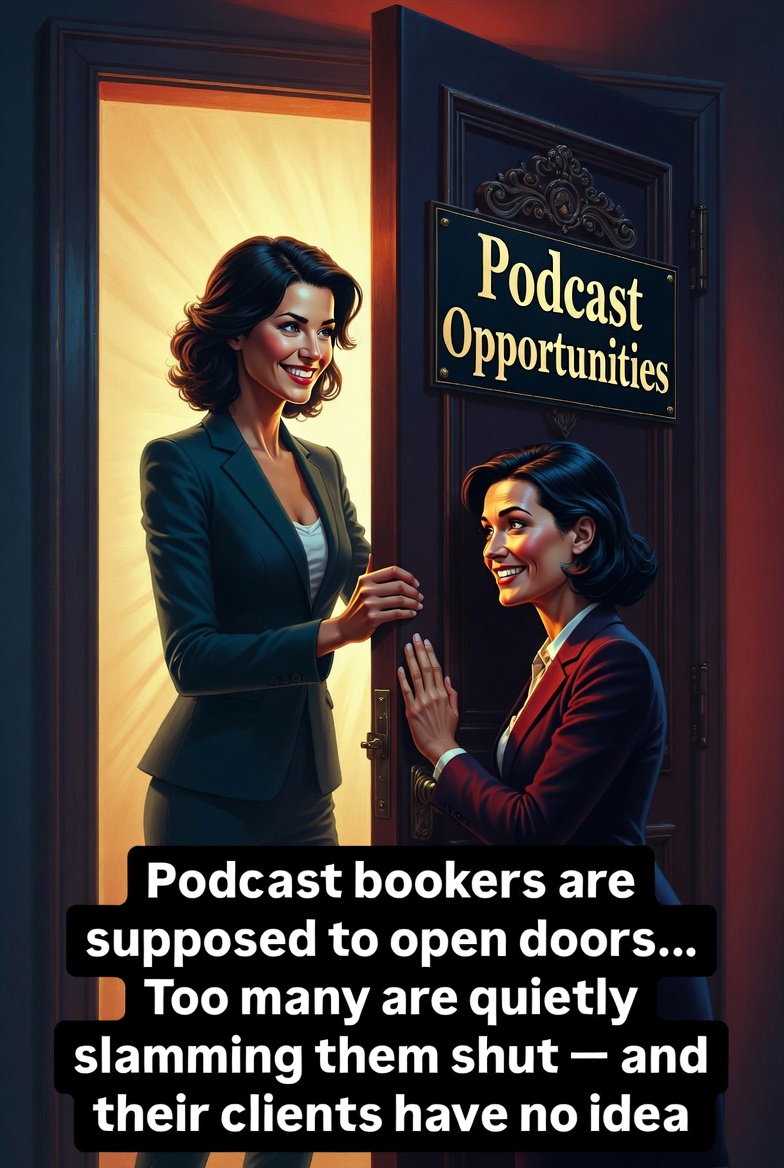
Podcast bookers are supposed to open doors for their clients. Too many of them are quietly slamming those doors shut — and their clients have no idea.
By Denise Griffitts, Host of Your Partner In Success Radio · Part 1 of a continuing series
Every morning, I open my inbox to the same scene: dozens of pitch emails, most of them unsolicited, most of them wrong. Wrong show. Wrong angle. Wrong tone. Sometimes wrong name at the top — as in, they've addressed me as someone else entirely (This happens a LOT!). I've watched this phenomenon grow from a minor nuisance into something that genuinely concerns me, not just as a host, but as someone who cares about the integrity of public discourse and the professionals who navigate it.
Let me be clear: I want great guests. Finding them is among the most rewarding parts of this work. A pitch that makes me lean forward, that connects a compelling person to a timely conversation is a gift. But that kind of pitch has become increasingly rare — drowned out by a tide of mass-blasted, templated, copy-pasted outreach that treats podcast hosts as interchangeable receptacles for whoever a booker is trying to place that week.
The damage isn’t done to me. I delete the email and move on. The damage is done to the client — the expert, the author, the executive — who paid someone to represent them and got their credibility quietly trashed instead.
What troubles me most about this pattern is who pays the price. Not the booker. Not the agency collecting a retainer. The person being pitched — the author with a new book out, the executive with something genuinely worth saying, the advocate for a cause that deserves a platform — is the one whose reputation silently suffers every time a lazy pitch lands in the wrong inbox. Hosts talk. Producers share notes. A name that shows up attached to five sloppy pitches in a month starts to carry baggage it didn’t earn.
This is not a small or abstract problem. It is an industry-wide failure of professional standards, and it is accelerating. The barriers to calling oneself a podcast publicist or booking agent are effectively zero. There are no certifications, no accountability structures, no consequences for practitioners who never bother to actually listen to the shows they’re pitching. The result is a marketplace flooded with operators whose primary skill appears to be sending email at scale.
I’ve decided to start writing about it directly — what these practices look like, why they backfire, and what legitimate, effective representation actually requires. Not to shame individuals, but to name patterns that are damaging real people and degrading a medium that, at its best, is genuinely extraordinary.
UPCOMING IN THIS SERIES
This is the first installment in an ongoing examination of professional malpractice in podcast booking and media placement. Coming entries will cover:
The mass-blast problem and why volume is not strategy; how generic pitches actively harm a guest’s positioning; the failure to research the show — and why hosts remember; what separates a real booking professional from someone with a Gmail account; and what clients should demand before hiring anyone to pitch on their behalf. If you’ve experienced any of this — as a host, a guest, or a publicist trying to do the work.
If you’ve experienced any of this — as a host, a guest, or a publicist trying to do the work well — I’d like to hear from you. Please connect with me on LinkedIn or email me directly at info@yourofficeontheweb.com.