






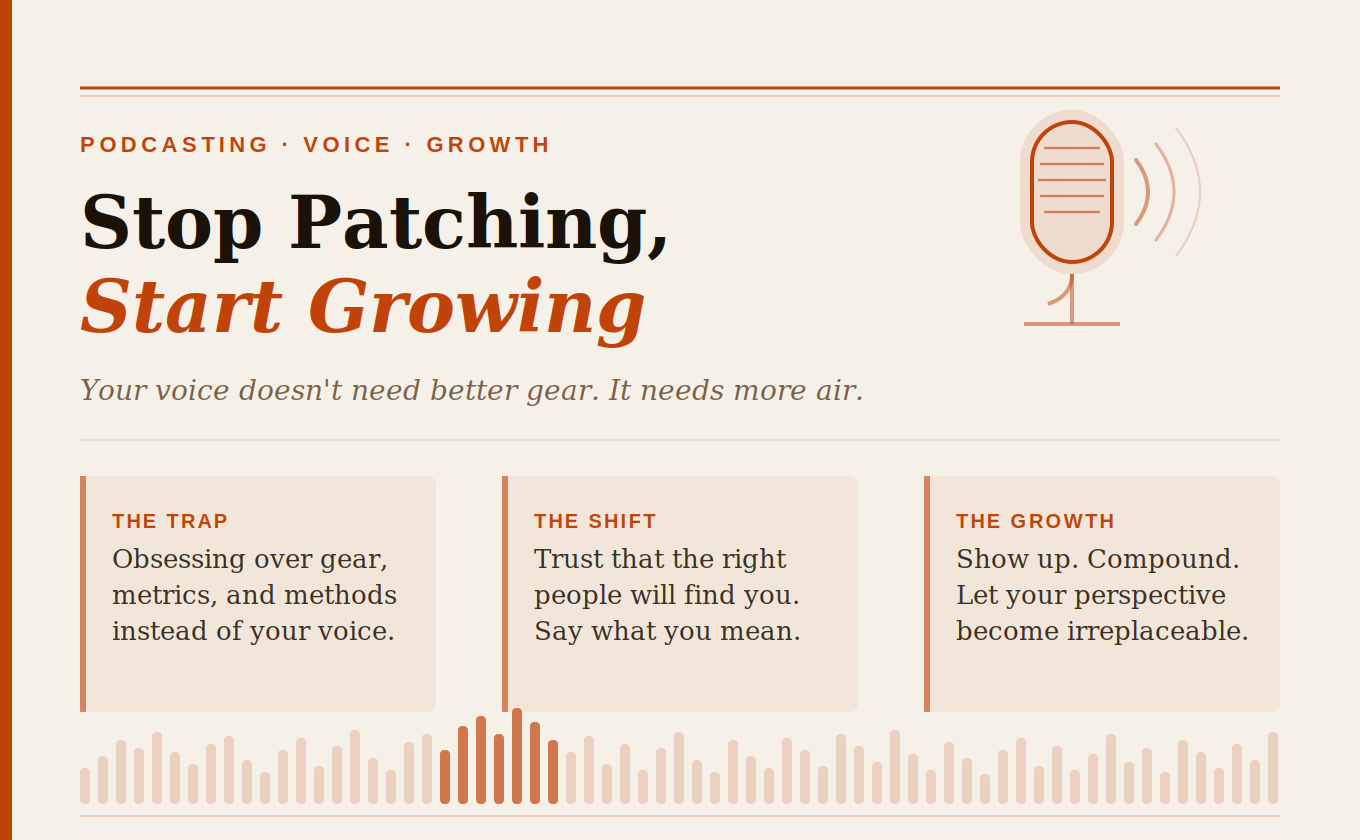
Why most podcasters are fixing the wrong things — and the mindset shift that will finally get your voice heard.
Most podcasters spend their first year patching. Patching the audio, buying a new mic, then a new interface, then acoustic foam panels for a closet that still sounds like a closet. Patching the format, cutting intros shorter, adding music beds, swapping episode structures every few months. Patching the numbers, obsessing over download counts, refreshing stats dashboards at midnight, treating every small dip as evidence that something is broken. Here's the truth no one tells you in those "grow your podcast" YouTube videos: patching is just fear wearing the costume of productivity.
Getting your voice heard has never been a technical problem. It is a growth problem, and growth requires a fundamentally different posture than fixing.
"Your audience doesn't discover you because your EQ settings improved. They find you because you said something they needed to hear."
The Patch Trap
Podcasting culture has a peculiar obsession with gear and metrics. Forums overflow with threads debating dynamic versus condenser microphones, optimal compression ratios, and the ideal episode length. These conversations feel productive. They have answers. But they quietly distract you from the harder, messier, more rewarding work: developing a genuine point of view and putting it into the world, repeatedly, until the right people find it.
The patch trap is seductive because it offers the illusion of control. You can't always control who listens. But you can absolutely buy a new pop filter. The danger is mistaking the controllable for the meaningful.
What Growing Actually Looks Like
Growing a podcast means investing in the things that compound. Your perspective compounds, the more episodes you record, the sharper and more distinct your voice becomes. Your relationships compound, guests become advocates, listeners become community members, conversations become collaborations. Your consistency compounds, every episode you publish is a small promise kept to your audience and to yourself.
It also means showing up in the rooms where your listeners already live. Write about what you discuss. Clip the moments that make people stop scrolling. Have real conversations in comment sections. Guest on shows where your future listeners are already tuned in. Growth is not a passive reward for good content. It is an active, social, generous act.
"Consistency is not just a discipline, it is the single most powerful signal that you believe in what you're building."
Your Voice Is the Product
The most enduring podcasts are not the ones with the cleanest audio or the most sophisticated production. They are the ones built around a voice you can't quite find anywhere else, a perspective that feels like it was made specifically for you, even when thousands of others feel exactly the same way. That specificity is not an accident. It is the result of a host who stopped trying to appeal to everyone and committed, fully, to saying what they actually think.
Stop asking, "What does my audience want to hear?" Start asking, "What do I need to say?" The difference between those two questions is the difference between a podcast that survives and one that matters.
The Only Fix Worth Making
There is one legitimate patch, and it has nothing to do with your setup. It's the quiet internal shift from "I hope this is good enough" to "I trust that the right people will find this." That shift changes everything, how you speak, how you promote, how you handle a bad episode, how you celebrate a good one. It is the foundation every successful podcaster eventually builds on, whether they realize it or not.
So close the microphone comparison tabs. Step away from the download analytics. Record the episode you've been putting off because you weren't sure the world was ready for it. Your voice does not need better equipment. It needs more air.
The microphone was never the problem. You were always enough.

Most podcasters are stuck in a loop — upgrading gear, tweaking formats, watching numbers — and wondering why nothing's moving. In my latest newsletter, I break down why that's the wrong game entirely.
The truth? Getting your voice heard isn't a technical problem. It's a growth problem. And fixing it starts with one shift: stop patching what isn't broken and start building what actually compounds — your perspective, your consistency, and your community.
I've spent years behind the mic as host of Your Partner In Success Radio and The Closers Inner Circle Podcast. I know what it takes to launch with intention, grow with purpose, and show up in a way that makes the right people stop scrolling.
If you're ready to stop fixing and start growing, let's talk.
I'm offering a FREE 15-minute podcast launch and strategy consultation — no fluff, no pitch, just a direct conversation about where you are and where you want to go. Email me at mail@yourofficeontheweb.com, Subject Line: Free 15-minute consultation. Or call me toll-free at 888-719-6711.
Let's get your voice heard!