






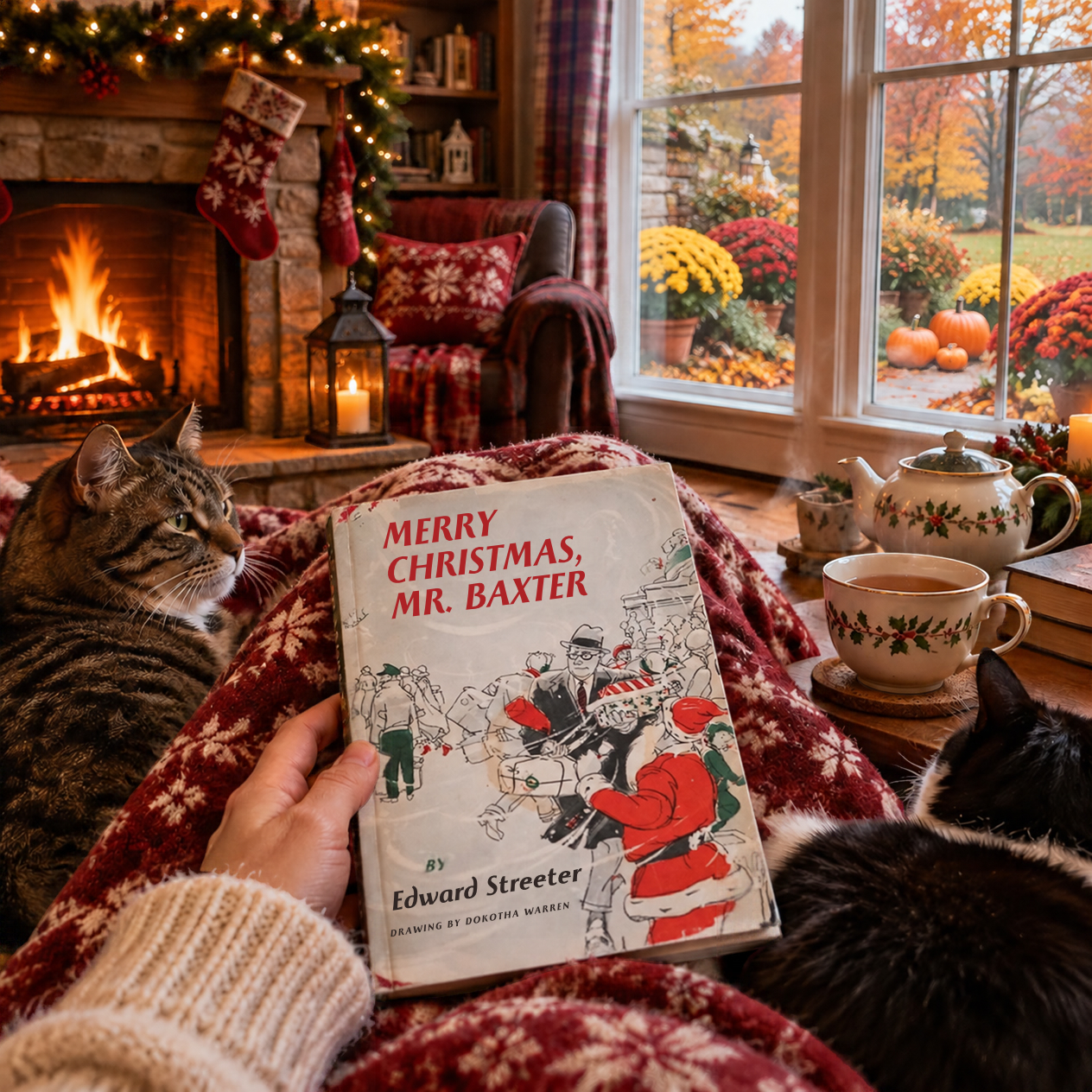
There is a moment every November, before the decorations go up, before the holiday music starts, before anyone has said the word “gratitude” out loud, when I go to the shelf and take down Merry Christmas Mr. Baxter.
It is not a Christmas tradition. It is a Thanksgiving one. And somehow that makes it more mine.
Edward Streeter wrote it the same decade he gave us Father of the Bride, that story everyone knows. But Mr. Baxter found me first, or maybe I found it. I was the kind of child who read everything within reach, which in our house meant quite a lot. I was reading at three. By the time most children were sounding out picture books, I was working my way through the Readers Digest condensed hardcovers that lined the bookcases flanking our fireplace, a full set, spine-out, serious and welcoming at the same time. We were all readers in my family. It was simply what we did, the way some families play cards or argue about football.
From those shelves I moved on to de Maupassant, to Agatha Christie, to anything that would sit still long enough. I read so far ahead of my speaking life that there are words I know perfectly well, can spell them, define them, use them in writing without a second thought, but hesitate over in conversation, because I have never once heard them said aloud. They came to me through the page, and the page kept them.
Merry Christmas Mr. Baxter climbed into my soul when I was young. That is the only way I know to say it. It climbed in and stayed.
My mother would tell you I stole it. She said so every time it came up, with that particular look mothers have when they are pretending to be more annoyed than they are. I always maintained that I had simply relocated it. Permanently. She has been gone a few years now, and I find I would give quite a lot to hear her make that accusation one more time.
I have moved that book to every house I have lived in since. It has sat on shelves in rooms I have loved and rooms I have been glad to leave. It has survived every edit of my life.
Autumn is my favorite season, which is its own small irony. I live in the Deep South, where fall does not so much arrive as simply exhaust itself. The leaves do not turn amber or crimson or gold here. They turn khaki, and then they fall down, as if the trees could not be bothered with the ceremony. So I make autumn myself. Pumpkins on the steps, orange mums blazing in the flower bed, a fire in the fireplace whether the temperature strictly calls for it or not. The tea hot, the book open, and nowhere else I need to be.
In that small constructed season, with the fire and the tea, it is exactly enough. I reach for that book and open it again, not out of habit exactly, but out of something that feels more like keeping a promise, to the season, to the story, and to the girl who first read it, and to the mother who was called to school because a kindergarten teacher had decided her daughter was a liar. My mother, all five feet nothing of her, walked into that room and flatly told that woman that I could read. The teacher, apparently unimpressed, asked how a child my age could possibly manage such a thing. My mother looked at her and said, “Because we never told her she couldn’t.” Then she took me home. That answer has lived with me ever since, tucked between the pages of every book I have ever loved.
From my constructed autumn to yours, wherever you are and however your leaves fall, happy Thanksgiving.