





Effective: Maybe the Problem Isn't You
Have you ever had one of those days when you've been working nonstop...
Emails.
Messages.
Meetings.
Notifications.
Projects.
More meetings.
More messages.
And at the end of the day, you're exhausted but still wondering:
What did I actually accomplish?
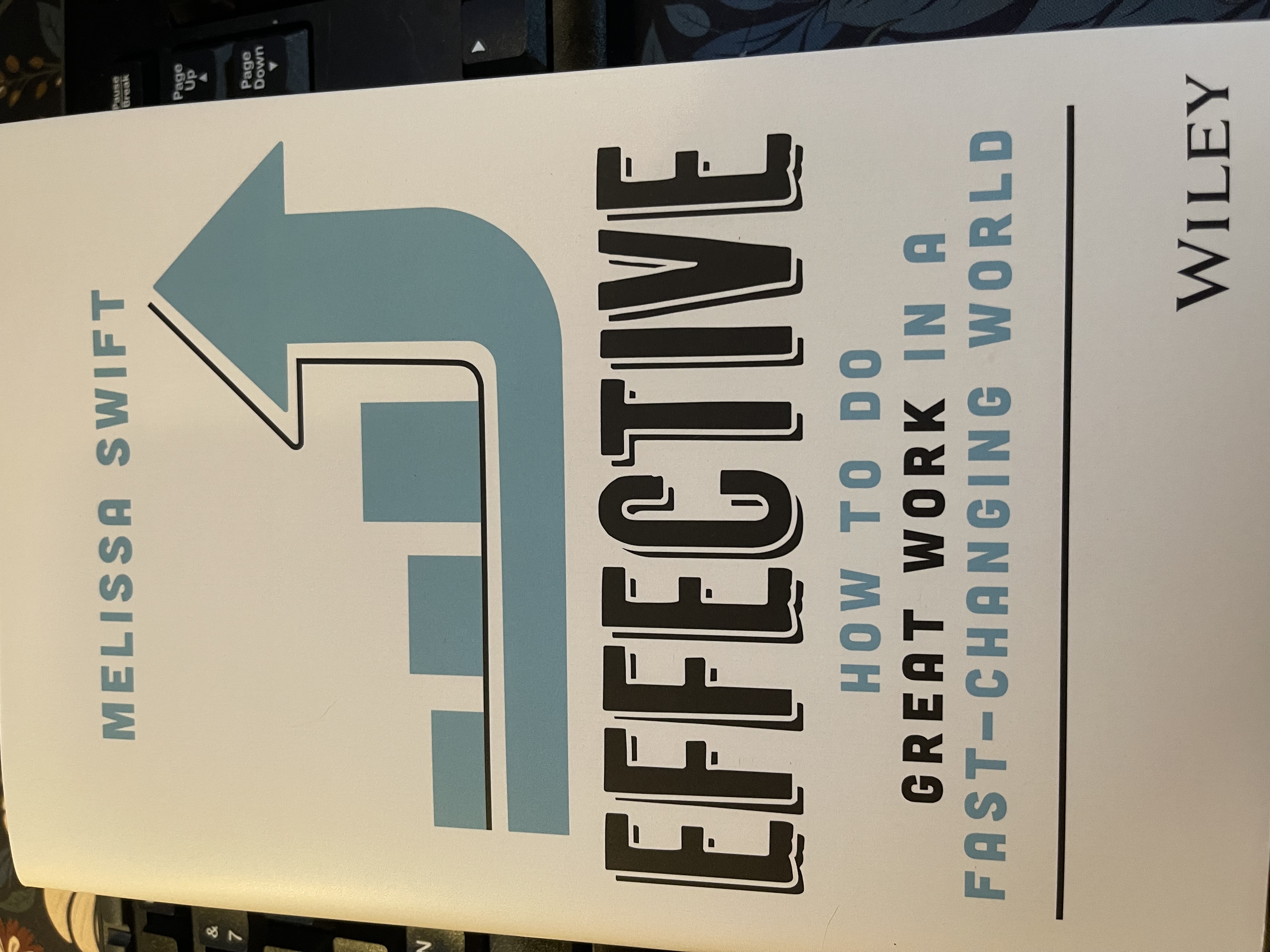
Melissa Swift's Effective: How to Do Great Work in a Fast-Changing World begins with a premise that I think a lot of us need to hear:
Maybe you're not bad at your job. Maybe the world of work has simply become much harder to navigate.
And frankly, that's a relief.
We're Working in a Very Different World
The modern workplace isn't just busy. It is increasingly fragmented, intensified, emotional, transparent, and chaotic.
Swift identifies four forces that are making work harder: work intensification, emotional inflection, hyper-transparency, and sheer chaos.
If you own a business, lead a team, work for someone else, or manage projects and clients, you probably recognized at least three of those before you finished that sentence.
And then there's technology.
We were promised that technology would make our work easier.
Instead, many of us now have five different ways to be interrupted before breakfast.
And AI is adding another layer of change to an already unstable environment.
So how do we remain effective when the rules keep changing?
That's the question Swift tackles.
Stop Chasing Productivity
One of the things I appreciate about Effective is that it isn't another book telling you to wake up at 5 a.m., color-code your calendar, or somehow squeeze another hour out of a day that is already completely packed.
Swift takes a different approach.
She introduces what she calls the Effectiveness Architecture, built around four elements: Knowledge, Methods, People, and Technology.
Think of those as the structural pieces that allow you to consistently do good work.
If one is weak, effectiveness suffers.
If the environment changes, your architecture needs to be able to withstand that change.
That is a much more useful way to think about effectiveness than simply asking whether you are "productive."
Because being busy isn't the same thing as being effective.
We all know people who are incredibly busy.
That doesn't necessarily mean they're accomplishing anything meaningful.
The Part Entrepreneurs Need to Hear
For entrepreneurs, this conversation gets particularly interesting.
When you're building a business, there is always more to do.
Always.
There is another email.
Another client.
Another opportunity.
Another technology to learn.
Another platform that supposedly changes everything.
Another problem that somehow lands on your desk because you're the owner.
And if you're not careful, your entire business becomes an exercise in reacting.
Swift's framework encourages us to step back and examine the underlying systems that make effective work possible.
That's something I wish more entrepreneurs would do.
Instead of asking:
"How can I get more done?"
Maybe we should be asking:
"What is making it difficult to do the work that actually matters?"
That's a very different question.
What Can We Learn From People Who Can't Afford to Get It Wrong?
Another fascinating element of Effective is Swift's examination of professions such as firefighting and air traffic control, where people operate in environments where mistakes can have serious consequences.
Those professions don't rely on heroic individuals simply working harder.
They rely on knowledge, methods, communication, technology, preparation, and systems that help people perform under pressure.
There's something there for every business owner.
Because while our mistakes may not involve an airplane landing on the wrong runway, they can still cost us customers, money, reputation, time, and trust.
Effectiveness Is Personal
Perhaps what I like most about this book is that Swift doesn't treat effectiveness as a one-size-fits-all formula.
She recognizes that people have different strengths, different ways of working, and different sources of effectiveness.
The goal isn't to turn everyone into the same kind of worker.
It's to understand what makes you effective and then build the conditions that allow you to keep being effective when everything around you changes.
That is a much more human approach to work.
And maybe that's exactly what we need right now.
Because the workplace isn't slowing down.
Technology isn't slowing down.
Change certainly isn't slowing down.
So perhaps the answer isn't to run faster.
Perhaps the answer is to become better equipped for the environment we're actually working in.
That's what makes Effective such an interesting book for entrepreneurs, leaders, and anyone who is tired of feeling like they're constantly running but never quite getting anywhere.
You don't need another productivity hack.
You may need a better understanding of what makes great work possible.
And that's a conversation I'm very interested in having.
I'm looking forward to talking with Melissa Swift about Effective and what it really takes to do great work when the world around us keeps changing.
Because I'd much rather spend my time doing work that matters than simply doing more work.
And I suspect I'm not the only one.
This book is available on Amazon.